
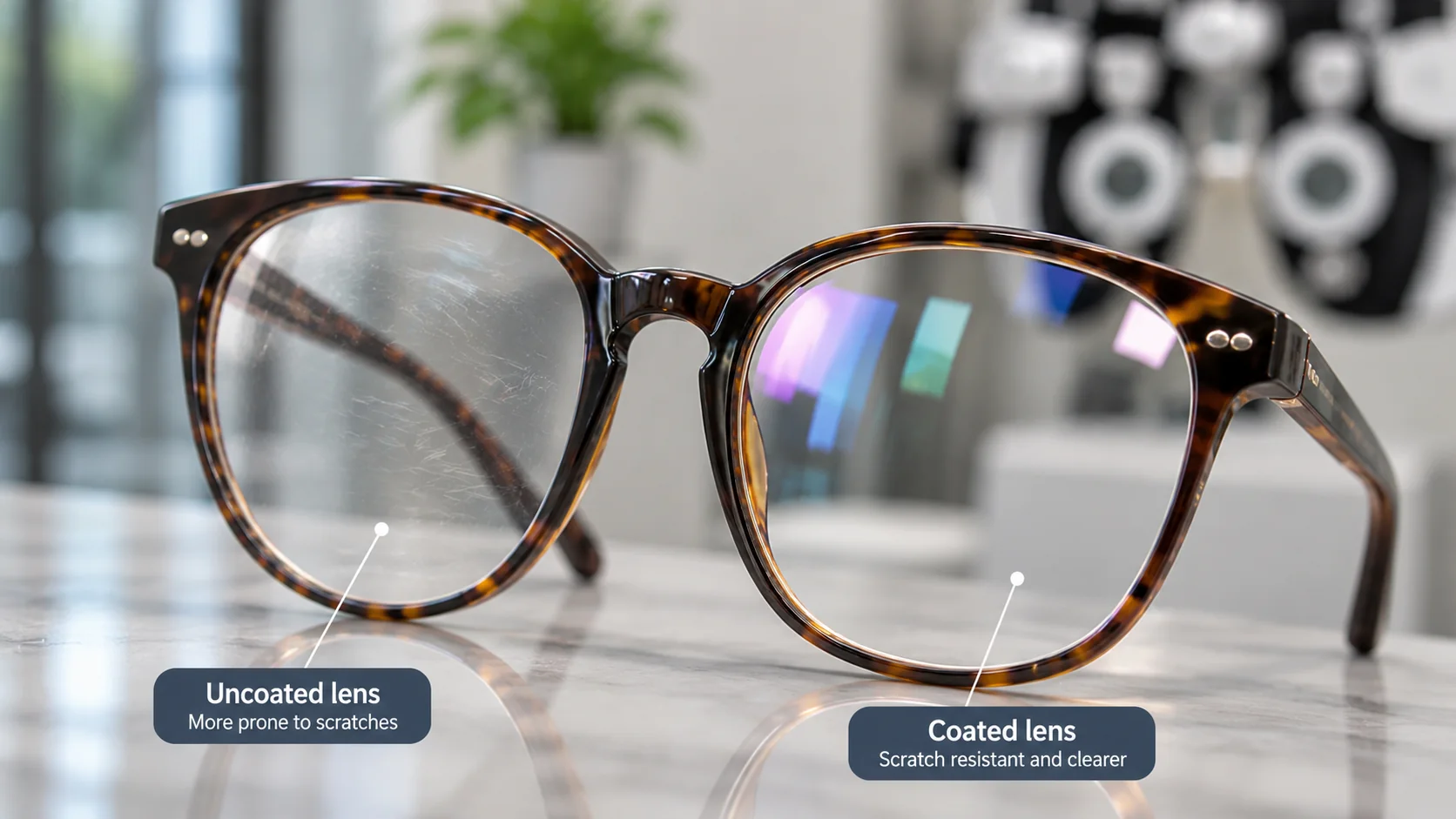
Find out how scratch resistant coatings help protect spectacle lenses, what causes fine scratches, and why hydrophobic and specialist anti fog coatings can behave differently when lenses meet warm, moist air.
Anti scratch coating is a surface treatment designed to help spectacle lenses withstand the small abrasions that can build up through everyday use. It is useful on many lens materials, including plastic and polycarbonate, but it does not make lenses impossible to scratch. Good cleaning and storage habits remain important.
People also search for anti scratch glasses, anti scratch lenses, a scratch resistant coating for glasses or polycarbonate scratch resistant coating. The exact performance depends on the lens material and coating package selected.
How does a scratch resistant coating work?
Some spectacle lens materials are lighter and more impact resistant than glass, but their surfaces can be more prone to marking. A hard coating adds a more abrasion resistant layer to the lens surface. It helps reduce the chance of fine marks from normal handling, so the lenses can stay clearer for longer.
A scratch resistant coating is a helpful layer, not a guarantee. Deep scratches, damage from abrasive cleaners, or repeated contact with grit can still mark the lens. If scratches become distracting or affect vision, ask an optician whether the lenses should be replaced; most scratches cannot be polished out safely without affecting the lens optics or coatings.
How do micro scratches form?
Dust and grit often contain tiny hard particles. If they are rubbed across a lens while dry, they can act like fine abrasive material. Wiping lenses with clothing, tissues or paper towels, putting them face down, or storing them loose in a bag can also contribute to a network of small marks over time.
What causes condensation on glasses?
Fogging is condensation. Warm air contains water vapour; when that moist air touches a cooler lens, some vapour turns into tiny liquid droplets on the surface. Moving from cold outdoors into a warm room, breathing into a face covering, cooking steam, exertion and perspiration can all create conditions where fog builds up. A larger temperature difference can make it happen faster.
Hydrophobic coatings and anti fog coatings
A hydrophobic coating repels water. It makes moisture less likely to spread evenly across the surface and can make droplets bead, move or wipe away more easily. This can help with water repellency and cleaning, and it may reduce the time moisture remains spread over the lens. However, beading water can still blur vision, so a hydrophobic coating should not automatically be described as a dedicated anti fog coating.
Purpose made anti fog coatings may use a different approach. Many are hydrophilic: instead of making droplets bead, they encourage condensation to spread into a thin, more uniform film that is less visibly misty. Some products combine anti fog and scratch resistant properties, but coatings differ between manufacturers and models. Check the stated specification for the glasses you are considering.
So, when discussing safety glasses anti fog anti scratch, it is worth checking that both functions are actually specified. A water repellent or easy clean topcoat, a hard scratch resistant layer and an anti fog treatment have related but distinct purposes.
Polycarbonate and scratch resistant coatings
Polycarbonate is a lightweight, impact resistant lens material often chosen for children’s eyewear, sports eyewear and some protective applications. It can benefit from a hard coating that helps resist surface abrasion. A polycarbonate scratch resistant coating still cannot make the lens scratch proof; follow the care advice for the particular lens and avoid abrasive materials.
Anti scratch safety glasses: check the protection standard
Anti scratch safety glasses are intended to offer more than ordinary everyday spectacles, but coating alone does not establish that eyewear is protective. The frame and lenses must be suitable and certified for the specific workplace risks, such as impact, dust or chemical splash. Follow your employer’s safety guidance and check the markings and product documentation.
Searches for glare resistant glasses may refer to reduced reflections, a tint, or protective eyewear designed for a particular job. Scratch resistance does not itself reduce glare. If you are choosing protective glasses, identify the hazard and required standard first, then consider prescription and coating options.
Bollé anti fog safety glasses
Bollé anti fog safety glasses are one example of branded protective eyewear people may look for. Certain Bollé Safety models list anti fog and scratch resistant features, but specifications vary by model and product line. We can check whether a requested model is available to order and review its stated features; asking for a brand name alone does not confirm that it is suitable for a particular workplace or available in a prescription version.
Choosing coatings for your glasses
The right lens treatment depends on how you use your glasses, the lens material and whether your main concern is scratches, reflections, water droplets, or fogging. Our team at Specialeyes Eyecare in Shepherds Bush can talk through available lens and coating options and help you understand what each one is designed to do.
Frequently asked questions
What does an anti scratch coating do?
It adds a harder surface layer that helps lenses resist everyday abrasion and micro scratches. It does not make lenses scratch proof, so careful cleaning and storage still matter.
How do micro scratches form on glasses?
Fine particles such as dust or grit can be dragged across a lens during dry wiping. Contact with rough surfaces, clothing, paper towels or a case can also leave marks over time. Rinse off loose debris and use a clean microfibre cloth or suitable lens cleaner.
Does a hydrophobic coating stop glasses from fogging?
A hydrophobic coating repels water and can make moisture bead up and clear more easily, but it may not prevent fogging. Purpose made anti fog coatings often work differently: a hydrophilic surface spreads condensed moisture into a thin, more even film.
Why do glasses fog when I come indoors?
Fog forms when water vapour in warm, moist air condenses into tiny droplets on a cooler lens. A sudden temperature change, breath or perspiration can make this more noticeable.
Are anti fog and anti scratch coatings the same?
No. They address different problems, although some safety eyewear coatings combine both functions. Check the specification for the exact frame and lens rather than assuming one coating provides both.
Are anti scratch safety glasses suitable for every workplace?
The correct protective eyewear depends on the hazards and required protection. Check that the complete eyewear, including its frame and lenses, is certified for the task; a scratch resistant coating alone does not make ordinary glasses safety rated.
Can you get Bollé anti fog safety glasses?
Bollé Safety offers models with particular anti fog and anti scratch specifications. Availability and suitability vary by model; ask us to check the product details and whether it can be ordered for your requirements.
Ask about lens options
Visit Specialeyes Eyecare in Shepherds Bush to discuss spectacle lenses, materials and coating choices.
Prescription glasses and lensesCall 020 8743 7552128 Uxbridge Road, Shepherds Bush, London W12 8AA · Monday to Saturday, 10:00am–6:00pm
Further information
This article provides general information and is not a substitute for personalised optical advice or an eye examination. Information reviewed 29 October 2026.