
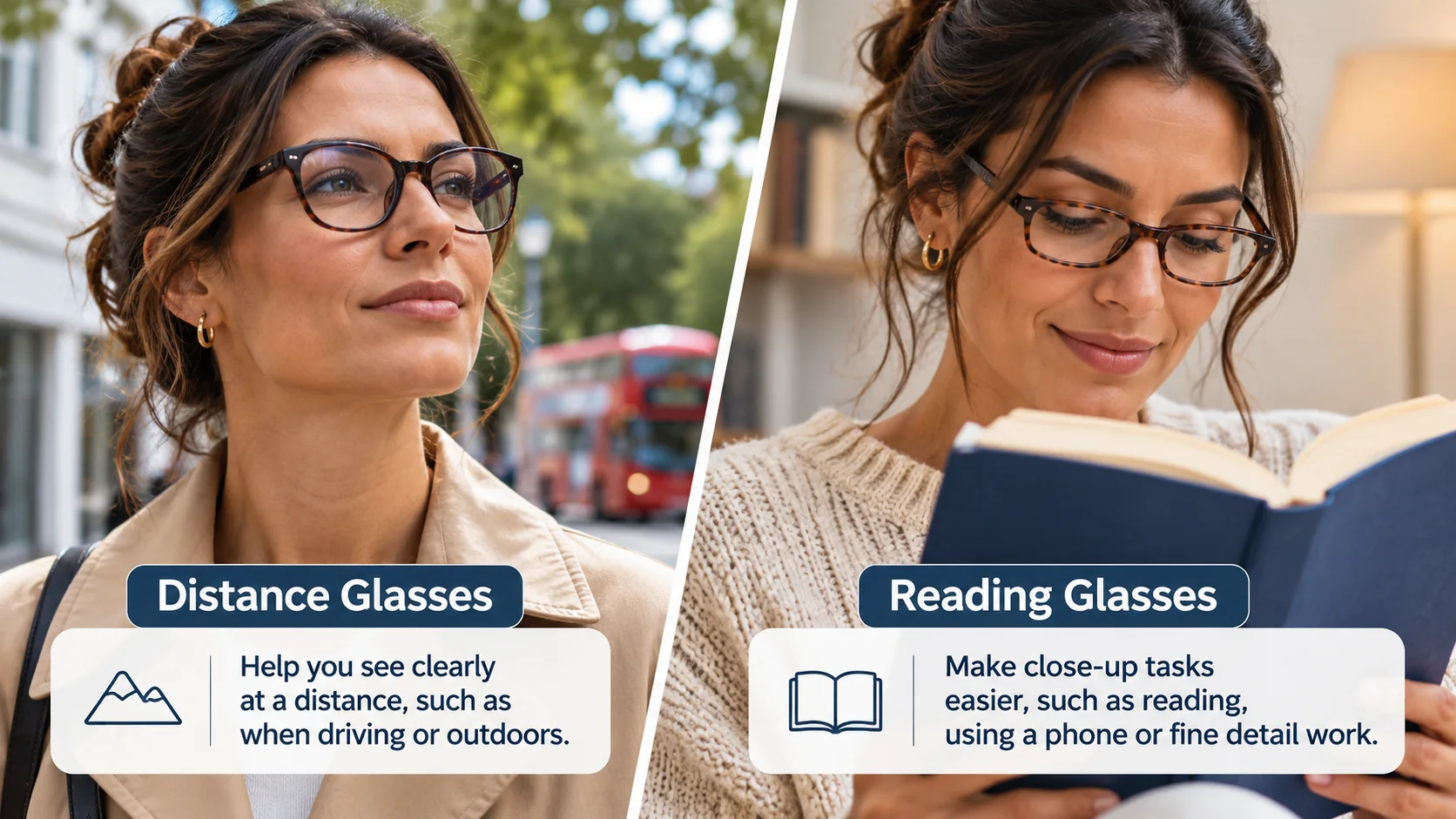
Distance glasses are prescribed to help you see clearly at a distance. If you are younger, your natural eye lens can usually change focus between far and near objects. As the eye’s focusing ability changes with age, you may need separate glasses for reading or computer work as well as your distance pair.
What are distance glasses for?
Distance lenses correct refractive errors such as short sightedness, long sightedness and astigmatism so that distant objects are clearer. The prescription may be for full time wear or for particular activities, depending on your eyes and the advice from your optometrist.
When we are younger, the natural lens inside the eye can change shape to bring near objects into focus. This focusing ability is called accommodation. So a person who wears distance glasses may still be able to read comfortably through them when young, depending on their prescription and the task.
Why near vision can change: presbyopia
As we get older, the natural lens gradually becomes less flexible and the eye cannot accommodate as easily. This normal age related change is called presbyopia. Close work may become harder, or you may find yourself holding reading material farther away. It commonly becomes noticeable in midlife, though timing and symptoms vary.
With presbyopia, you may need reading glasses for close work and, depending on your screen distance, intermediate glasses for computers or desk tasks. Some people prefer separate pairs; others may be suited to bifocals, varifocals or occupational lenses. The right option depends on your prescription, working distances and daily activities.
Read our guide to varifocal glasses for an overview of one option for combining different viewing distances. An eye test can help establish whether the change is presbyopia or another cause of blurred vision.
Glasses after cataract surgery or an IOL implant
During cataract surgery, the cloudy natural lens is removed and replaced with an artificial intraocular lens, or IOL. A standard monofocal IOL has one main focus and does not provide the natural accommodation of the original lens. Many people choose a lens target intended to give useful distance vision, and then use reading glasses for close work. Some may also need distance glasses for residual prescription or fine focusing.
That does not mean every person with an IOL will need the same pair of distance and reading glasses. The lens target, the prescription after surgery, the other eye, and the type of implant all affect the result. Some people have a multifocal or extended depth of focus lens, or a planned difference between the eyes, which may reduce dependence on glasses for certain tasks. These options do not guarantee spectacle independence, and your cataract team can explain what to expect for your own eyes.
After surgery, follow your hospital team’s advice about when your vision has settled and when to arrange new glasses. The NHS notes that people may still need glasses for reading or distance after cataract surgery. You can read its cataract surgery recovery guidance and the Royal Free London guide to vision and glasses after cataract surgery.
How to tell which glasses you need
- Think about the distance: note whether blur is at far away, computer or reading distance.
- Describe the task: mention driving, screens, reading, hobbies and whether you switch between distances.
- Bring your current glasses: they help the optometrist understand what you use and what has changed.
- Mention eye surgery: tell the optometrist if you have had cataract surgery or another IOL procedure, and when it took place.
- Arrange an eye test: a sight test checks your prescription and eye health before you decide on new lenses.
Visit our page about prescription glasses and lenses in West London, or arrange an eye test in Shepherds Bush.
Frequently asked questions about distance glasses
Can I read with my distance glasses?
Many younger people can read through their distance glasses because the natural lens can accommodate. As presbyopia develops, near work may become harder and reading glasses or another lens design may help.
Will I need reading glasses after cataract surgery?
Many people do, particularly when a standard monofocal IOL is targeted for distance vision. The outcome depends on the IOL choice and your prescription. Your cataract team can explain the likely result, and your optometrist can advise when to update your glasses.
Will I need both distance and reading glasses after an IOL implant?
Not necessarily. Some people need reading glasses, some need distance correction, and some need both or neither for certain tasks. It depends on the lens target, surgery result and the type of IOL.
What are intermediate glasses?
Intermediate glasses are designed for mid range tasks such as computer screens or desk work. They may be useful when reading glasses do not focus comfortably at your usual screen distance.
Discuss your distance and reading vision
If your distance or near vision has changed, Specialeyes Eyecare can check your eyes and discuss suitable glasses options. We are at 128 Uxbridge Road, Shepherds Bush, London W12 8AA, and open Monday to Saturday, 10am–6pm.
Call 020 8743 7552 or book an eye test online. You can also message us on WhatsApp.