
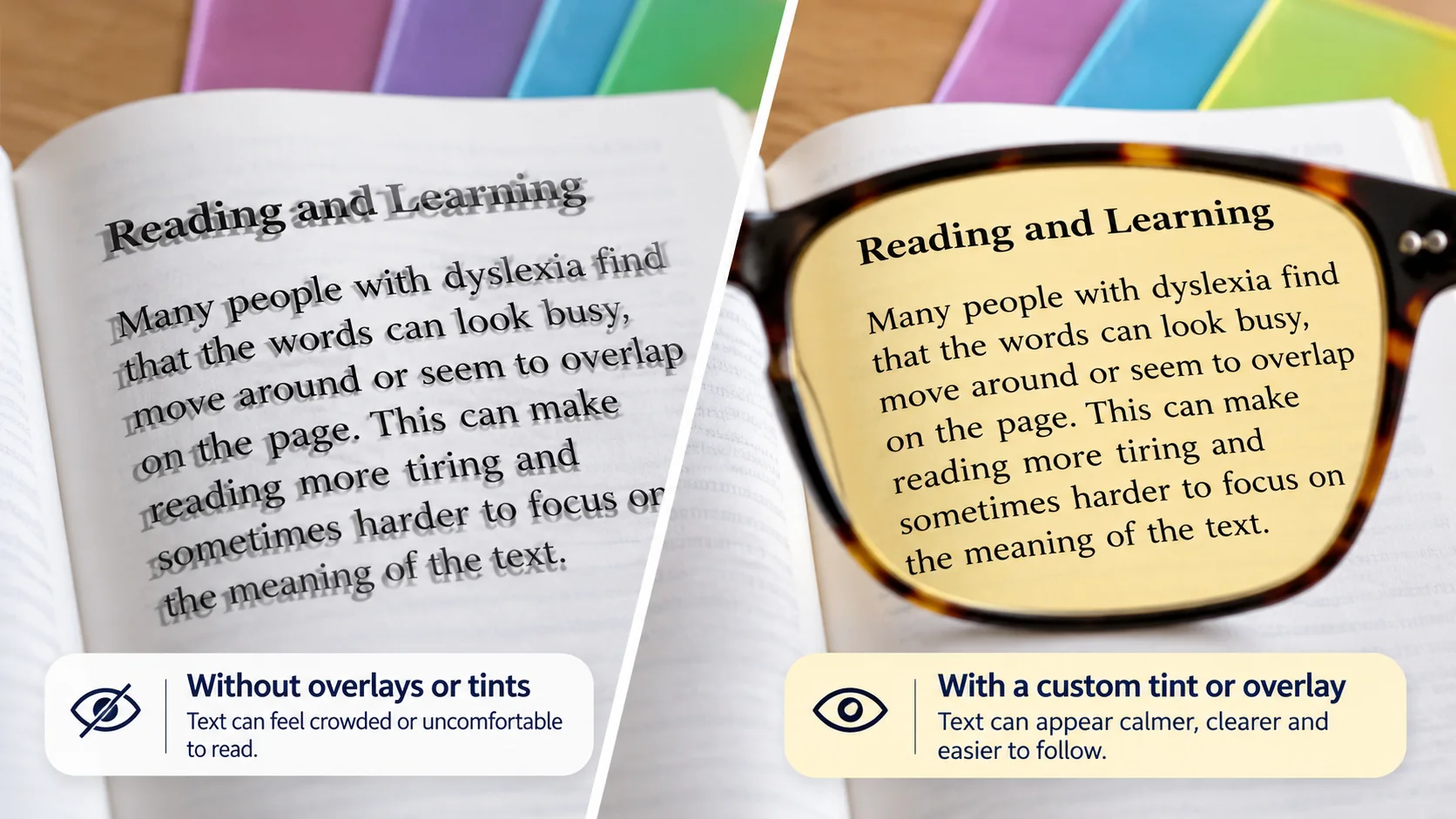
Some people with dyslexia also experience visual discomfort when reading. An eye examination can check for vision problems and refractive error. Coloured overlays and custom tints may be explored for visual comfort, but they are not a treatment for dyslexia.
What do people mean by dyslexia glasses?
Dyslexia glasses is a phrase people use for glasses with coloured lenses that they hope may make reading more comfortable. Searches such as tinted glasses for dyslexia, overlay glasses for dyslexia and glasses to help with dyslexia often relate to visual discomfort when reading. Dyslexia is a learning difference; tinted lenses do not treat or cure dyslexia.
Some people experience visual discomfort, such as glare, words seeming to move or blur, or eye strain during reading. These symptoms can have different causes and should be assessed by a registered optometrist. The British Dyslexia Association advises a full assessment of eye health and visual function for visual difficulties, and stresses that treating visual difficulties is not treatment for dyslexia.
Dyslexia and glasses: check vision and refractive error
An eye examination can identify refractive errors such as short sightedness, long sightedness or astigmatism. If blur or focusing strain is contributing to reading difficulty, the correct prescription lenses may improve visual clarity and comfort. Correcting a refractive error can help with vision, but it does not treat dyslexia or replace appropriate literacy support.
Prescription lenses for someone with dyslexia may be clear or tinted, depending on the person’s needs and the outcome of assessment. The phrase prescription dyslexia glasses should not imply that there is a special prescription that treats dyslexia.
What happens in a dyslexia glasses test?
A “dyslexia glasses test” is not a test for dyslexia. An optometrist can perform an eye examination to assess eye health, focusing and vision, and identify refractive error that may need correction. If reading remains visually uncomfortable, overlays or further assessment for visual stress may be discussed. A coloured overlay or tint assessment cannot diagnose dyslexia.
Trying overlays and considering a custom tint
At Specialeyes Eyecare, we can use coloured overlays as part of exploring reading related visual discomfort. An overlay is placed over the page so the person can compare how the text feels to read through different colours. We can then discuss whether a custom spectacle tint may be appropriate for the person’s reported symptoms.
Discuss reading comfort, lighting and your prescription with our optometrist. We can consider suitable lens options around your individual needs and arrange a custom tint order where appropriate.
Dyslexia reading glasses and coloured lenses
People searching for dyslexia reading glasses may be looking for help with reading fatigue or visual discomfort. A thorough eye examination should come first, so that eye health issues and refractive error can be addressed before considering overlays or tints. Any overlay or lens option should be presented with realistic expectations and monitored for whether it makes a meaningful difference during everyday reading.
Discuss reading comfort, lighting and your prescription with our optometrist. We can consider suitable lens options around your individual needs and arrange a custom tint order where appropriate.
Questions about Specsavers or NHS dyslexia glasses
Searches such as Specsavers dyslexia glasses or dyslexia glasses Specsavers may reflect people comparing local options. The important point is to find a registered eye care professional who assesses vision and explains what overlays or tints can and cannot do.
People searching for dyslexia glasses NHS should know that an NHS sight test can assess eye health and refractive error for people who are eligible. Coloured overlays or precision tints are not included in every standard sight test, and local availability varies. The British Dyslexia Association notes that some additional visual stress assessments may be outside the scope of a standard NHS sight test.
Book an eye examination
Discuss reading comfort, lighting and your prescription with our optometrist. We can consider suitable lens options around your individual needs and arrange a custom tint order where appropriate.
Visit us at 128 Uxbridge Road, Shepherds Bush, London W12 8AA, or call 020 8743 7552.
Frequently asked questions
Do dyslexia glasses treat dyslexia?
No. Dyslexia is a specific learning difficulty, and tinted lenses or overlays should not be described as a treatment or cure for dyslexia. Some people report improved visual comfort when reading, but benefits vary and the evidence is uncertain.
Can tinted glasses help with reading discomfort?
Some people with visual discomfort report that a particular colour filter makes reading feel more comfortable. Coloured filters do not help everyone, and a preferred overlay colour does not guarantee the same benefit from spectacle lenses.
Can prescription glasses help someone with dyslexia?
Prescription glasses can correct a refractive error such as short sightedness, long sightedness or astigmatism. Clearer vision may help reading comfort when blur or strain is present, but glasses do not treat dyslexia itself.
How do overlays and custom tints work?
A coloured overlay can be tried over reading material to see whether the reader reports a sustained improvement in visual comfort. If an overlay appears helpful, a suitable custom spectacle tint can be discussed; the final tint may differ from the overlay colour.
Are dyslexia glasses available on the NHS?
An NHS sight test can assess eye health and refractive error when someone is eligible. Coloured overlays and precision tints are not part of every standard NHS sight test, and availability depends on local services and clinical need.
Are blue dyslexia glasses right for everyone?
Discuss reading comfort, lighting and your prescription with our optometrist. We can consider suitable lens options around your individual needs and arrange a custom tint order where appropriate.
Contact Specialeyes Eyecare
To discuss an eye examination or visual comfort when reading, visit us at 128 Uxbridge Road, Shepherds Bush, London W12 8AA or call 020 8743 7552.
Clinical review
Clinically reviewed by: Hayder Ali, Qualified Optometrist
Last clinically reviewed: