
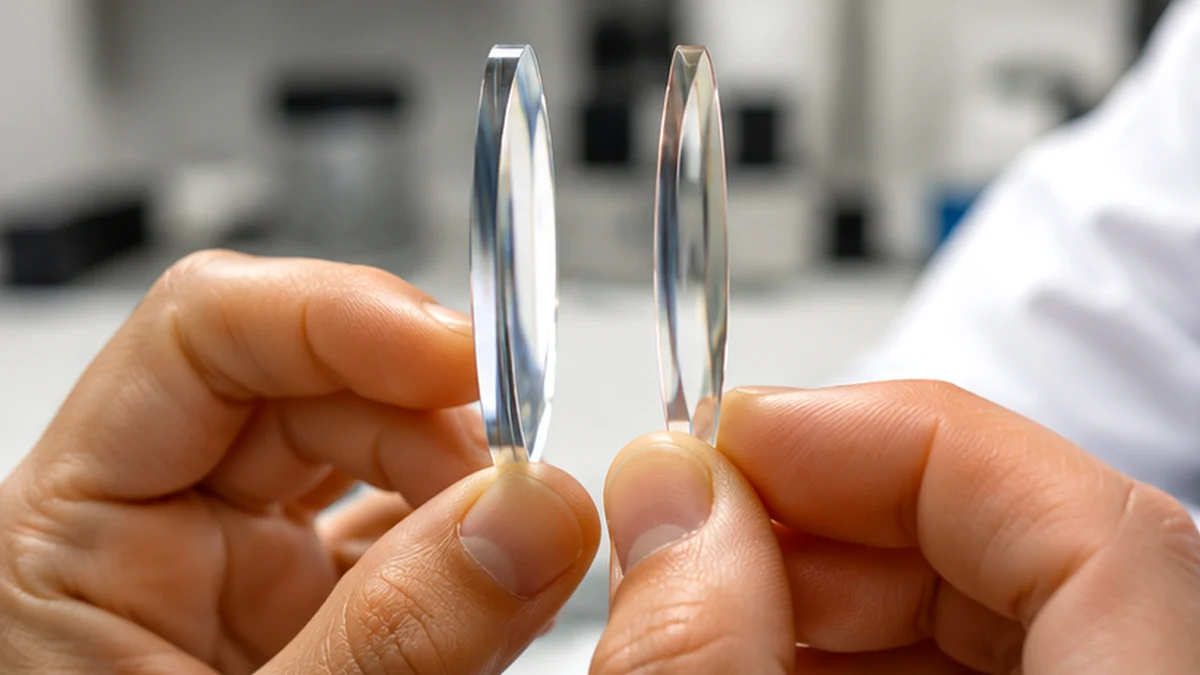
Compare 1.50 standard plastic, 1.59 polycarbonate, 1.60, 1.67, 1.74 and 1.90 glass lenses, including thickness, weight and cost.
What does high index mean?
High index spectacle lens materials are used to achieve thinner lens designs for suitable prescriptions. You may see options described with numbers such as 1.67 and 1.74. These numbers identify a material property; they are not a complete rating of the quality or suitability of the finished pair of glasses.
Compare the finished glasses
Ask the dispenser to compare options using your actual prescription and chosen frame. Discuss thickness, weight, appearance and the lens design together. Manufacturer claims about thinner or lighter lenses depend on the comparison being made, so a headline percentage should not be treated as a personalised prediction.
Separate material from other choices
When comparing quotes, ask which lens material is included and which coatings or design features are being priced separately. A higher index does not answer every question about the lenses. The right discussion should also cover how you use your glasses, the frame you prefer and any practical fitting constraints.
Are cheap high index lenses good value?
A useful comparison looks at the whole specification and the fitting support, not just the lowest advertised price. Ask whether the quote includes the required prescription, measurements, coatings and any relevant remake or adjustment terms. If you are keeping an existing frame, have its suitability assessed before committing to replacement lenses.
What should I ask before ordering?
Request an explanation of what changes between the proposed material options and which difference you are most likely to notice. Ask about availability for your lens design, including any tint or photochromic requirements. Choose after considering the complete pair of glasses rather than assuming the highest number is always the best use of your budget.
Comparing 1.67 high index and 1.74 lens options
A useful comparison is specific to the same prescription, frame and lens design. Ask what difference the dispenser expects in that finished pair, using your own prescription and frame measurements. Explain whether your main concern is edge appearance, overall weight, comfort or budget.
If two quotes use different frames, coatings or designs, the price difference cannot be attributed to index alone. Ask for the options to be set out clearly so you can understand which changes are included and which are optional.
High index lenses cost: what belongs in a quote?
For searches such as “1.74 high index lenses price”, the useful answer is an itemised quote for your own requirements. Check whether it covers the complete pair, the specified design and material, coatings, measurements, fitting and any applicable adjustment or remake arrangements.
Cheap high index lenses are only a meaningful comparison when the specifications and support are comparable. Ask the practice to explain any trade offs instead of treating the lowest starting price as the total cost of your finished glasses.
Varifocal and photochromic combinations
If you need high index varifocal lenses or high index photochromic lenses, ask which combinations are available for your prescription and chosen design. Availability varies between product ranges. Have the frame and full specification checked before assuming that every material can be combined with every treatment.
Lens indices at a glance: 1.50 to 1.90
Index describes how strongly a material bends light. Compare the material as well as the number: 1.90 glass and 1.74 plastic are different choices with different practical trade offs.
| Index | Material | What to discuss |
|---|---|---|
| 1.50 | Standard plastic | A useful baseline for comparing price and finished thickness. |
| 1.59 | Polycarbonate | An impact resistant plastic option; suitability also depends on the complete frame and lens system. |
| 1.60 | Higher index plastic | Compare its finished thickness with standard 1.50 plastic in your frame. |
| 1.67 | High index plastic | Consider alongside 1.60 and 1.74 for your prescription. |
| 1.74 | High index plastic | Check whether the extra reduction in thickness is worthwhile for you. |
| 1.90 | High index mineral glass | A specialist thin lens option; discuss weight, breakage risk and availability. |
Glass versus plastic spectacle lenses
Mineral glass has good scratch resistance and can be made in indices as high as 1.90. However, glass is denser than plastic: a thinner lens does not automatically mean a lighter pair of spectacles. Glass is also more vulnerable to breaking on impact, which makes the activity and frame choice important.
Plastic lenses are generally lighter and more resistant to breakage, although their surfaces benefit from appropriate hard coatings. Polycarbonate is one particular plastic material, with a nominal index of 1.59; it is not another name for every plastic lens. For protective eyewear, ask about the tested performance of the complete product.
The best choice balances thickness, weight, optical performance, durability and cost. Ask for a comparison using the same prescription, frame and design, and check current availability before assuming that 1.90 glass can be supplied in every lens type.
Frequently asked questions
Is 1.74 always better than 1.67?
Not automatically. Ask what the difference would mean for your particular prescription and frame, and whether that benefit justifies the cost for you.
Does a higher index replace anti reflective coating?
Material choice and surface coating options are separate parts of the specification. Ask which coatings are included and why they are being recommended.
Can I put high index lenses into my existing frames?
Ask for the frame to be assessed first. Suitability depends on its condition, construction, your prescription and the intended lenses, so an existing frame should not be accepted on its brand name alone.
Related reading
- A Guide to Understanding Your Spectacle Prescription
- Anti Reflective Coating for Glasses: Anti Glare Lenses Explained
Sources and further information
ZEISS: plastic or glass lenses · ZEISS: single vision materials, including polycarbonate 1.59