
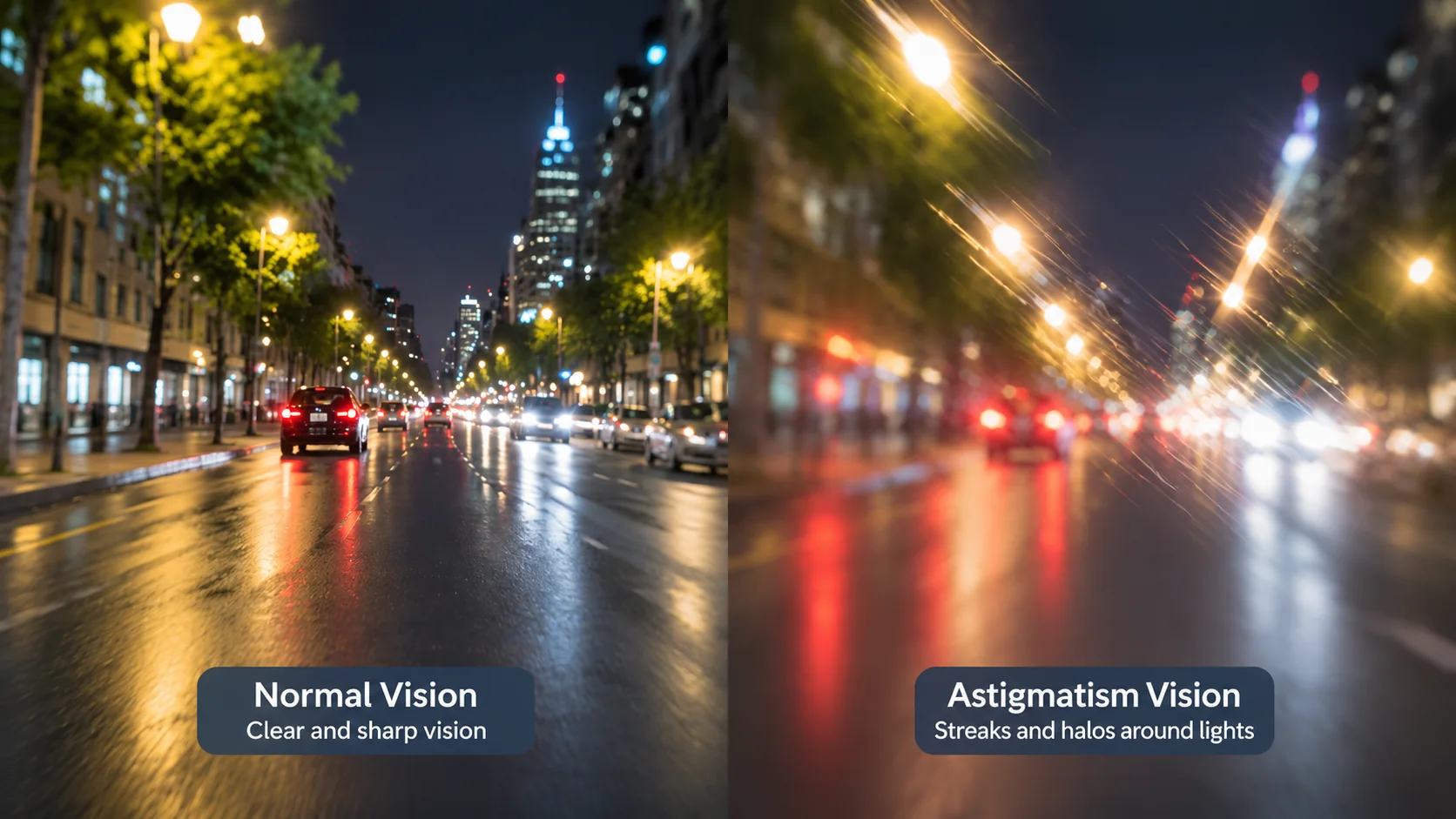
Astigmatism can make vision look blurred or distorted, and lights may appear to streak or flare. Learn what astigmatism means and how prescription glasses can help.
Astigmatism is a common focusing error. It happens when the cornea at the front of the eye, or sometimes the lens inside the eye, has a different curve in different directions. Instead of bending light evenly to one sharp focus, the eye may focus it at more than one point. This can make near or distant vision seem blurred or distorted.
Astigmatism meaning: what is happening in the eye?
In an eye without significant astigmatism, the cornea is evenly curved, helping focus light clearly on the retina at the back of the eye. With astigmatism, the curve is more oval or uneven. Light is then focused differently depending on its direction, so outlines may look soft, stretched or shadowed.
The meaning of astigmatism in the eye is not that the eye is damaged or diseased. Astigmatism is a refractive error and is often present alongside short sightedness or long sightedness. Its amount and direction are measured during a refraction, and the prescription may include a cylindrical power and axis to correct it.
How astigmatism can cause streaks in vision
When the eye does not focus light evenly, small bright sources can appear less sharply defined. Some people with uncorrected or under corrected astigmatism notice that headlights, streetlights or other bright points look like streaks, rays, starbursts or smudged lines. The direction and amount of distortion can vary depending on the type and degree of astigmatism.
This effect may be more noticeable in dim conditions, when bright lights stand out against a darker background. Streaks around lights can be associated with astigmatism, but they are not specific to it. Reflections from glasses, dry eyes, cataract and other eye conditions can also affect how lights look.
How prescription glasses can reduce streaking
Astigmatism correction in glasses uses a precisely oriented cylindrical lens power. It compensates for the eye’s uneven focusing in a particular direction, helping light form a clearer image on the retina. When the prescription is appropriate and the lenses are accurately made and fitted, glasses can improve clarity and may reduce streaking or distortion caused by astigmatism.
The improvement varies. Some people notice a substantial difference, while others may still see some glare or streaking because another factor is involved or because the astigmatism is irregular or more complex. Glasses reduce the refractive blur from astigmatism; they do not treat every possible cause of light distortion. An anti reflective coating may reduce reflections from the lens surfaces, but it does not replace the astigmatism correction.
Common signs and symptoms
Astigmatism may cause blurred or distorted vision at different distances. Other possible symptoms include squinting, tired eyes, headaches or eye strain, particularly after sustained visual tasks. Some people have only a small amount and notice few symptoms.
Only an eye examination can confirm whether astigmatism is present and whether it needs correcting. A refraction helps determine the prescription; your optometrist can also assess eye health and consider other explanations for symptoms.
When to arrange an eye check
If your vision is blurry, lights have become streaky, or your glasses no longer seem to work well, arrange an eye examination. This is especially useful if the change is new, persistent or affecting tasks such as driving at night. Do not assume every streak or halo is caused by astigmatism.
At Specialeyes Eyecare in Shepherds Bush, our optometrists can assess your vision and discuss whether prescription glasses may help with astigmatism. The correct lens powers and measurements help place the optical centres appropriately for your eyes and chosen frame.
Frequently asked questions
What does astigmatism mean?
Astigmatism is a common refractive error where the cornea or lens has an uneven curve. This can stop light from focusing to one sharp point on the retina and make vision blurred or distorted.
Can astigmatism make lights look like streaks?
Yes. Uncorrected or under corrected astigmatism can make lights look streaky, fuzzy, doubled or star shaped because light is not focused evenly. Other eye or lens issues can also cause these effects.
Can glasses reduce streaks around lights?
Prescription glasses with the appropriate cylindrical correction can help focus light more evenly and may reduce blur or streaking caused by astigmatism. The effect varies by person, and glasses cannot rule out other causes.
Does everyone with astigmatism need glasses?
Not always. Mild astigmatism may not need correction if it does not affect vision or comfort. An optometrist can assess your prescription and visual needs.
Are streaks of light always caused by astigmatism?
No. Streaks, halos or glare can have several causes, including reflections, dry eye, cataract or other eye conditions. New or persistent changes should be assessed by an eye care professional.
Book an eye examination
Visit Specialeyes Eyecare in Shepherds Bush for an eye examination and personalised advice about your prescription.
Eye tests at Specialeyes EyecareCall 020 8743 7552128 Uxbridge Road, Shepherds Bush, London W12 8AA · Monday to Saturday, 10:00am–6:00pm
Further information
- NHS: Astigmatism
- American Academy of Ophthalmology: Astigmatism explained
- American Academy of Ophthalmology: Streaks of light and glasses
This article provides general information and is not a substitute for personalised optical advice or an eye examination. Information reviewed 29 October 2026.
Clinical review
Clinically reviewed by: Hayder Ali, Qualified Optometrist
Last clinically reviewed: