
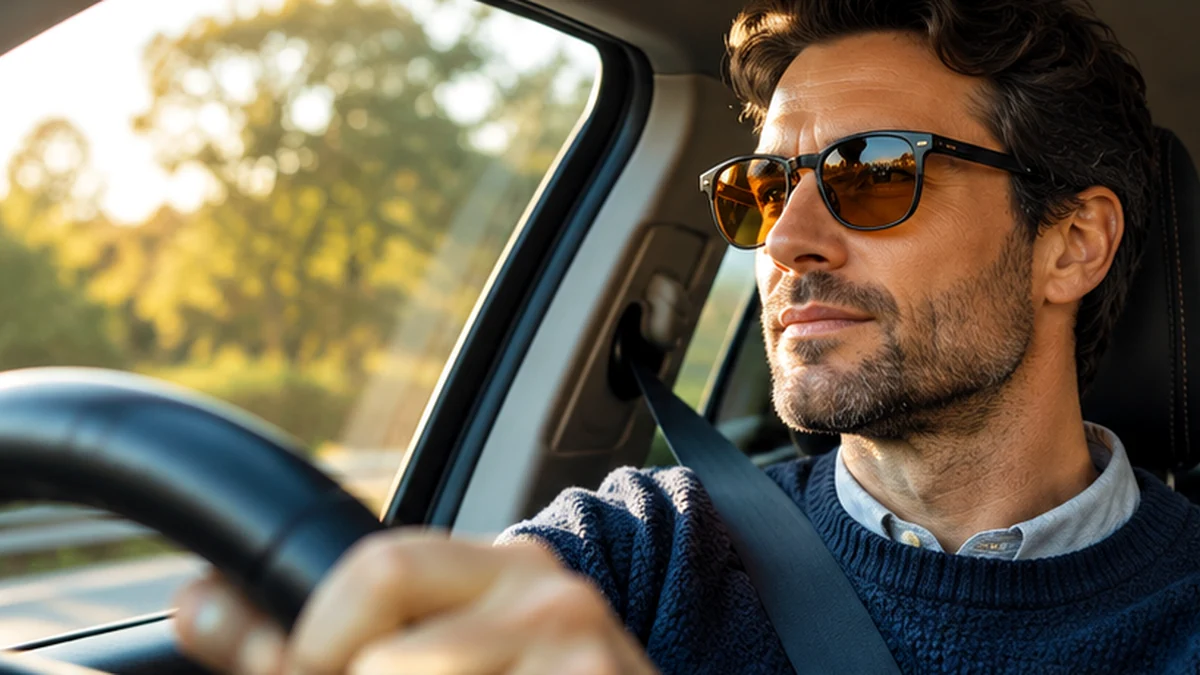
Explore golden brown driving tints, gradient lenses and the light transmission requirements for daytime and night driving.
Driving tint options
A driving tint is golden brown, with UV and blue light filtering. The manufacturer recommends a gradient from brown orange towards yellow orange. The darker upper area manages overhead brightness while the lighter lower area allows a view towards the dashboard.
We provide driving tint options. Our optometrist will discuss your prescription, daytime driving needs and appropriate lens specification before arranging your lenses.
Why some drivers choose a gradient
A gradient tint is darker at the top and lighter towards the bottom. For some people it feels useful when looking from a bright windscreen towards a dashboard, but the exact light transmission varies across the lens. Check that the final product is appropriate for driving and does not make instruments or road hazards harder to identify.
Driving guidance: daylight, twilight and night
Daytime driving filters must meet the requirements for visible light transmission and recognition of traffic signals. Category 4 sunglasses are unsuitable for driving. Lenses transmitting less than 75% of visible light are unsuitable at twilight or at night.
For night driving, clear lenses with the appropriate prescription and an anti reflective coating can address refractive blur and reflections from the lens surfaces. New or worsening glare should be assessed at an eye examination.
UV protection and daytime glare
Appropriate UVA and UVB protection is useful in sunwear, but UV blocking does not tell you whether the tint is comfortable for driving or suitable for recognising traffic lights. Polarised lenses may reduce reflected road glare for some drivers yet affect the view of some screens, so compare the full setup rather than assuming one feature is always best.
Prescription and lens design matter
An accurate distance prescription, suitable anti reflective treatment and a comfortable, well positioned frame matter for driving. Ask how a gradient, photochromic or polarised option behaves behind your windscreen. Some photochromic lenses do not darken in a car as they do in direct sunlight.
Comparing anti glare driving glasses
When comparing products, separate the tint from an anti reflective surface coating, UV protection and polarisation. Ask which of those features the quote includes and why each is being recommended for your needs. Different features should not be treated as interchangeable simply because they appear under an anti glare label.
Our optometrist will discuss the prescription, frame, tint and protective features for your activity. We arrange the lenses to suit your individual order and explain their care at collection.
Frequently asked questions
Can I drive at night with a yellow or golden brown lens?
Driving lenses must meet the requirements for light transmission and traffic signal recognition. Category 4 lenses are unsuitable for driving, and lenses transmitting less than 75% of visible light are unsuitable at twilight or at night.
Does a gradient make a lens legal for driving?
Driving lenses must meet the requirements for light transmission and traffic signal recognition. Category 4 lenses are unsuitable for driving, and lenses transmitting less than 75% of visible light are unsuitable at twilight or at night.
Are ordinary sunglasses safe for viewing an eclipse while driving?
No. Never look directly at the Sun through ordinary sunglasses, whether driving or standing still. Solar viewing needs a different, specialised filter.