
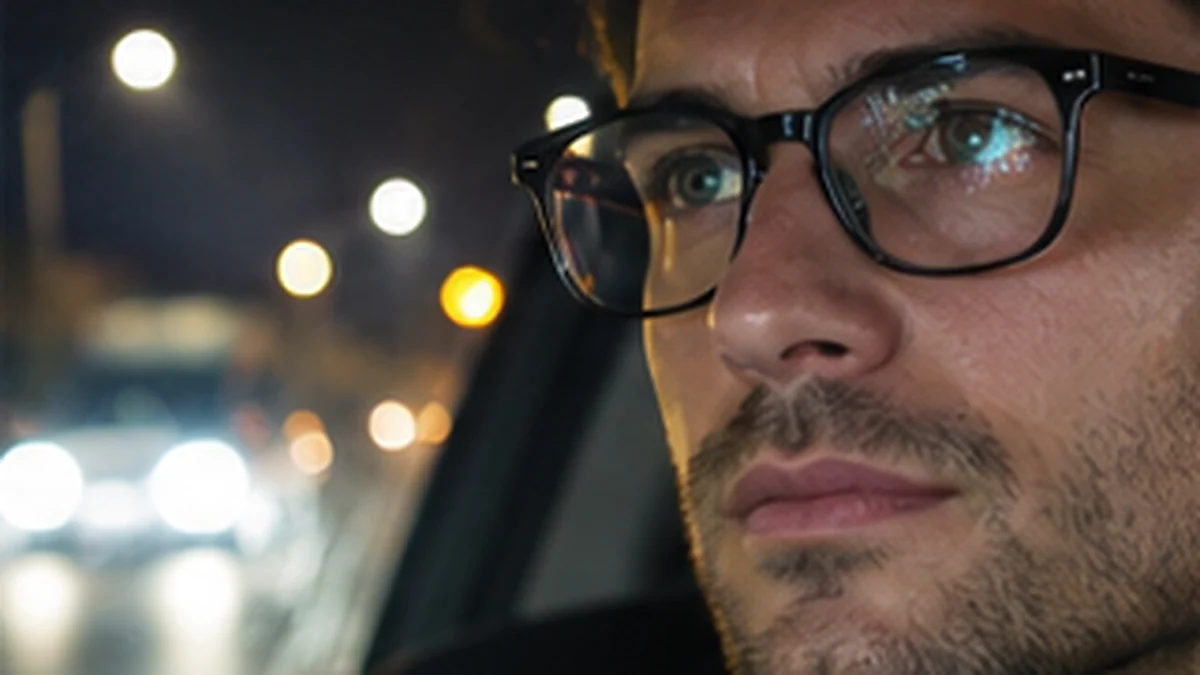
People searching for night time driving glasses, night driving glasses or eye glasses for night driving may be looking for help with several different symptoms: dazzling headlights, blurred road signs, difficulty seeing in low light or streaks around streetlights. The best solution depends on what is causing the problem. A pair of special “night vision glasses” cannot correct every cause of glare.
Searches such as “night time driving glasses anti glare” and “night time vision glasses” can refer to clear prescription lenses, coatings or tinted products. Check what a lens is designed to do: a suitable prescription can correct refractive blur, while a coating can reduce reflections from the spectacle lenses.
Common night driving vision symptoms
Drivers may notice that oncoming headlights seem uncomfortably bright, that lights have halos or starbursts, or that the road and signs are harder to distinguish after sunset. Some people can see adequately in daylight but find that they struggle to see at night, particularly on wet or poorly lit roads.
Low light can make an existing prescription issue more noticeable. Astigmatism, short sightedness or an outdated distance prescription may contribute to blur or distortion. Dry eye, cataract and other eye conditions can also affect night vision and light sensitivity, so symptoms should not automatically be blamed on a glasses prescription.
Astigmatism and night driving
With astigmatism, the front surface of the eye or its internal lens focuses light unevenly. This can make bright points of light look streaky, smeared or less sharply defined. The effect may be more apparent when driving in the dark, when bright lights stand out against a darker background.
An accurate astigmatism correction in your glasses can improve focus and may noticeably reduce this kind of blur. If your astigmatism night driving symptoms continue despite wearing your prescribed glasses, an optometrist can check the prescription and consider other possible causes.
How the right prescription can help
A refraction checks how your eyes focus and determines whether you need a prescription or an update. If night time blur is caused by uncorrected short sightedness, astigmatism or another refractive error, the right driving glasses may make a substantial and sometimes dramatic difference to clarity. Wear your prescribed glasses or contact lenses whenever they are needed for driving, including at night.
Accurate lens powers and fitting measurements matter. If your current night time glasses for driving are scratched, poorly fitting or no longer match your prescription, they may not give you the clearest view. An eye examination can help establish whether a new prescription is appropriate and whether eye health factors need attention.
Anti reflective driving glasses and headlight reflections
An anti reflective coating reduces reflections from the front and back surfaces of spectacle lenses. Some people who choose anti reflective driving glasses or anti glare driving glasses find that reducing these lens surface reflections makes lights less distracting.
The coating reduces glare produced by reflections at the lens surfaces; it does not block direct light from headlights or reduce the headlight beam itself. It cannot remove every source of glare or treat an eye condition. Keep both your glasses and windscreen clean, because smudges and dirt can scatter light and add to visual discomfort.
Clear prescription lenses with an appropriate anti reflective coating may be worth discussing if reflections from your glasses are troublesome. The coating does not replace an up to date prescription or an eye examination.
Night vision glasses, tints and driving sunglasses
The phrase night vision glasses is often used for clear glasses with a prescription or coating, as well as for yellow tinted products. A tint does not correct an inaccurate prescription. Dark or yellow tinted lenses also reduce the light reaching your eyes, so tinted “night driving glasses” should not be assumed to improve night vision. Guidance from eye care professionals advises checking that any tint is suitable for the lighting conditions.
Driving sunglasses can help with bright daylight, but sunglasses or dark lenses are not suitable for driving after dark because they reduce available light. If you use prescription glasses, ask an optician about clear lenses and coatings matched to your needs rather than relying on a tint to solve night time glare.
When to arrange an eye examination
Book an eye examination if you are newly struggling to see at night, if headlight glare has become more troublesome, or if your vision is blurred even when wearing your usual glasses. A change in night vision can sometimes be related to cataract or another eye health issue as well as prescription changes.
If vision changes suddenly or significantly, seek prompt professional advice. Do not continue driving when you feel that you cannot see safely. Specialeyes Eyecare in Shepherds Bush can check your vision and discuss whether prescription night time driving glasses or lens options may help.
Practical ways to manage headlight glare
- Wear your prescribed glasses or contact lenses whenever they are needed for driving.
- Keep your glasses, windscreen, mirrors and headlights clean; smears can scatter light and increase glare.
- Use working windscreen wipers and demisting settings so the windscreen stays clear.
- Avoid staring into oncoming headlights. Keep your lane position and look toward the left edge of your lane when dazzled.
- Reduce your speed and leave more room if visibility is poor. Stop somewhere safe if you cannot see well enough to continue.
- Book an eye examination if headlight glare or night time blur is new or persistent.
These measures can help reduce avoidable distractions, but they do not make it safe to drive if your vision is inadequate.
Frequently asked questions
Can glasses help with bright headlights at night?
If blur or distortion is caused by an uncorrected or outdated prescription, the correct glasses may make a substantial difference. Anti reflective coating may also reduce reflections from the lens surfaces, but it does not dim or block direct headlight beams.
Can astigmatism make night driving harder?
Astigmatism can cause blur or distortion and may make bright points of light appear streaky or smeared. A suitable prescription can correct refractive blur, although not every cause of night glare is due to astigmatism.
Do yellow night vision glasses reduce headlight glare?
Tinted lenses reduce the amount of light entering the eyes and are generally not a solution for night driving. Clear lenses with an appropriate prescription and anti reflective coating may be more suitable, depending on the cause of symptoms.
What should I do if I am struggling to see while driving at night?
Arrange an eye examination, especially if the problem is new or worsening. Avoid driving when you cannot see safely, and seek urgent advice for sudden significant vision changes.
Are driving sunglasses suitable after dark?
Sunglasses and dark tinted lenses reduce the light reaching the eyes, so they should not be used for night driving. Keep driving sunglasses for appropriate daytime conditions.
Book an eye examination
Visit Specialeyes Eyecare at 128 Uxbridge Road, Shepherds Bush, London W12 8AA, or call 020 8743 7552 to discuss your vision and glasses.
Further information
- College of Optometrists: advice about wearing glasses for night driving
- College of Optometrists: tints and driving
- NHS: Astigmatism
- NHS: Cataracts and night time vision symptoms
This article provides general information and is not a substitute for personalised optical advice or an eye examination. Information reviewed 30 October 2026.
Additional guidance
Clinical review
Clinically reviewed by: Hayder Ali, Qualified Optometrist
Last clinically reviewed: