
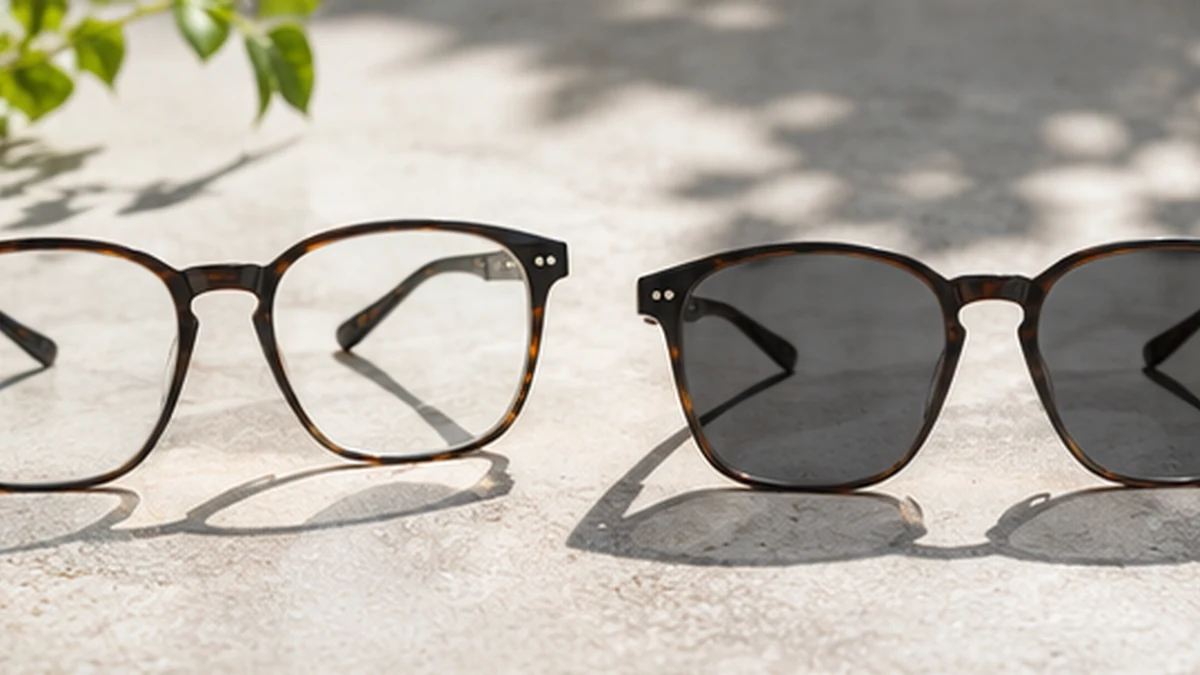
Photochromic lenses offer a convenient way to adapt to changing light, with affordable options for prescription glasses. Photochromic is the general term for lenses that change tint; Transitions is one well known brand, and there are other photochromic lenses to choose from.
What are photochromic glasses and lenses?
Photochromic glasses have lenses that react to light: they are lighter indoors and darken outdoors when exposed to suitable light. They are sometimes called light adaptive or reactive lenses, and people may also search for them as photochromic sunglasses or transition lenses.
The term photochromic describes the lens technology. Transitions is a brand name. You can buy standard photochromic lenses from other manufacturers, so not every photochromic lens is a Transitions lens.
A good value alternative
Standard photochromic lenses can be a remarkably affordable way to get one pair of glasses that adjusts as you move between indoor and outdoor settings. They are a useful option for people who want everyday convenience and would like to keep the cost of their prescription glasses down.
Choosing a standard photochromic lens does not mean that it is unsuitable or poor quality. Different products have different features, colours, activation behaviour and prices. We can explain the available choices and help you select a lens that suits your routine and budget.
Standard photochromic lenses and Transitions compared
| Feature | Standard photochromic lenses | Transitions lenses |
|---|---|---|
| What the name means | A general category of lenses that change tint with light. | A branded range of photochromic lenses. |
| Choice | Features vary between manufacturers and lens designs. | Several branded options are available, with features varying by product. |
| Price | Often available as a lower cost option. | Pricing depends on the product, prescription and coatings. |
| Driving | Conventional UV sensitive lenses may darken less behind a windscreen. | Some products, including XTRActive, are designed to activate more in the car. |
This is a general guide: the exact performance depends on the chosen lens. If you would like to compare a standard option with a specific Transitions product, we can show you the differences and confirm the price before ordering.
Colours, prescriptions and coatings
Photochromic lenses are commonly available in colours such as grey and brown, with other colours offered in selected ranges. We can discuss options for single vision glasses and varifocal glasses, depending on your prescription and frame. Photochromic lenses are also available for many styles of RX eyeglasses.
You can customise compatible lenses with coatings such as anti reflective or scratch resistant treatments. Photochromic lenses can also be used in suitable RX eyeglasses, including selected Gucci frames, subject to the frame and prescription being suitable.
Photochromic lenses for driving
Car windscreens filter much of the ultraviolet light that activates many conventional photochromic lenses. As a result, standard photochromic lenses may remain lighter inside the car than they do outdoors. If you want your lenses to darken while driving, ask about a product specifically designed for greater activation behind a windscreen, such as Transitions XTRActive. Availability and darkness vary by product.
Photochromic lenses and blue light
Photochromic and blue light filtering describe different lens features. A photochromic lens changes tint in response to light; it is not automatically a pair of blue light glasses. Some lens products may combine features, but check the specification rather than assuming that a changing tint provides blue light filtering. Blue light for glasses is a separate choice we can explain when discussing your lens options. If you are searching for light blue glasses, tell us whether you mean a blue tinted look or lenses with a blue light filter, as these are different choices.
Choosing an affordable photochromic lens
When comparing photochromic glasses, consider how quickly the lens changes, the tint colour, how dark it becomes outdoors, whether you need varifocal or single vision correction, and which coatings you prefer. We can compare available lens designs at different price points so you can make an informed choice without paying for features you do not need.
Frequently asked questions
What does photochromic mean?
Photochromic is the general term for lenses that change tint in response to light. Transitions is a brand of photochromic lenses, and other manufacturers make photochromic lenses too.
Are standard photochromic lenses cheaper than Transitions?
Standard photochromic lenses can be a more affordable option. Prices and features vary by lens, prescription and coating, so we can compare current options with you.
Do photochromic lenses work in a car?
Many conventional photochromic lenses respond mainly to UV light, much of which is filtered by a car windscreen, so they may not darken as much inside a car. Some specialist lenses, such as Transitions XTRActive, are designed to activate more behind the windscreen.
Can photochromic lenses be varifocal?
Photochromic lenses can be made in selected single vision and varifocal designs. Availability depends on the lens, prescription and frame.
Are photochromic lenses the same as blue light glasses?
No. Photochromic describes a changing tint. Blue light filtering is a separate lens feature, and should be confirmed in the specifications for the exact lens.
Ask us about photochromic glasses
Visit Specialeyes Eyecare at 128 Uxbridge Road, Shepherds Bush, London W12 8AA to compare affordable photochromic lenses, Transitions products, varifocal options and coatings. Call 020 8743 7552 to ask about current prices and availability.
Clinical review
Clinically reviewed by: Hayder Ali, Qualified Optometrist
Last clinically reviewed: