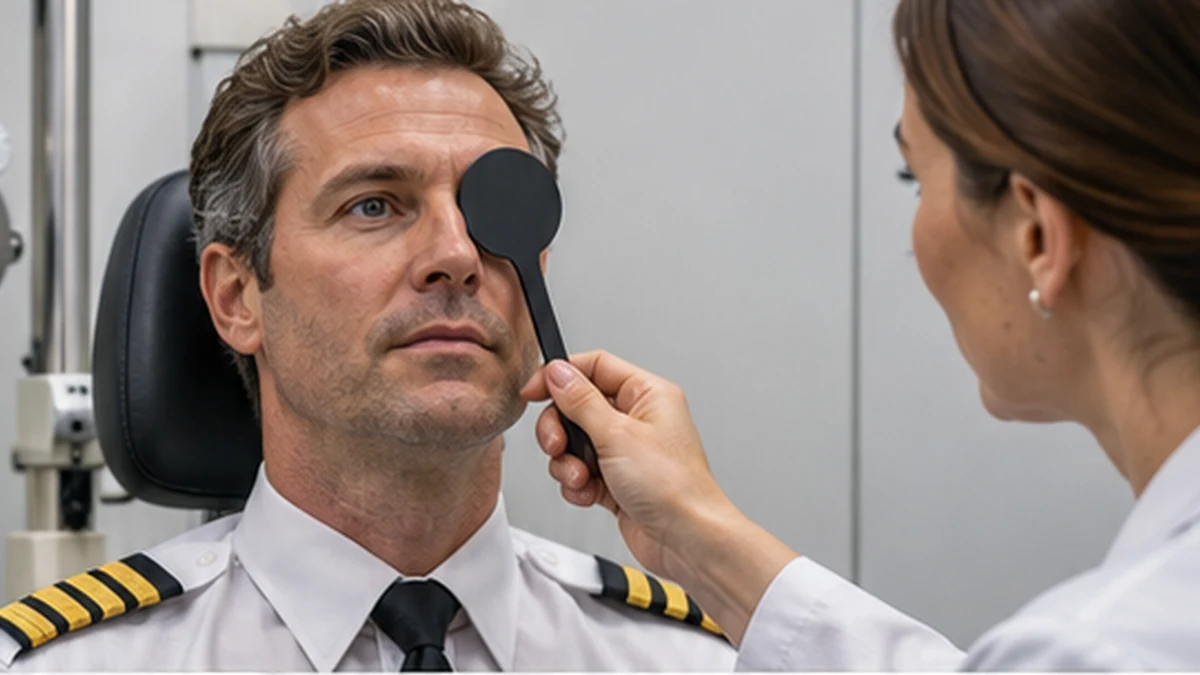
Specialeyes Eyecare provides EASA Class 1 medical appointments for aircraft and helicopter pilots in coordination with a specialist doctor. We carry out the eye and vision assessment, including mesopic contrast sensitivity testing. The doctor carries out the non eye related medical checks and examination. The tests required depend on the licensing authority, certificate type, examination stage and individual circumstances.
An aviation eye exam for pilots
An aviation eye exam or aviation eye test is part of the wider medical assessment used to determine whether an aircraft or helicopter pilot meets the visual requirements for their licence. It is more specific than a routine sight test for glasses. A normal optician eye test does not, by itself, replace the aviation medical or confirm that a pilot meets the applicable standard. Searches such as “pilot eye exam”, “pilot medical eye test” and “aviation medical eye test” often refer to this specialist vision assessment within the wider medical.
We work with pilots who need an EASA Class 1 medical eye test. Our optometry team completes the eye related assessment, and a specialist doctor works with us to complete the non eye related medical tests. The appropriate aeromedical examiner or centre manages the medical assessment and certification decision under the authority responsible for your licence.
What can the pilot vision assessment include?
The governing body’s requirements and your appointment type determine which tests are needed. Depending on those requirements, an eye test for pilots may assess:
- Distance vision: vision at distance, with and without your usual correction where required.
- Near and intermediate vision: clarity at reading distance and at an intermediate working distance.
- Visual fields: the area you can see around the point you are looking at, tested using the method required for your assessment.
- Mesopic contrast sensitivity: how well you can distinguish differences in contrast in lower light, mesopic conditions. We do this testing as part of the pilot eye assessment where required.
- Colour vision: a colour vision test may be required, especially at initial certification. Further testing or review may be needed if a screening result needs clarification.
- Eye health and function: the eye examination may include checks for relevant eye conditions and how the eyes work together.
For Class 1 assessments, the applicable visual system guidance describes near, intermediate and distance acuity, visual fields and mesopic contrast sensitivity among the elements of a comprehensive eye examination. The exact scope can vary between an initial examination and a routine renewal or revalidation, and additional checks may be requested when clinically indicated. Check the requirements for your licence and appointment with the aeromedical team before you attend. You can review the UK CAA visual system guidance.
The doctor’s part of the aviation medical
The Class 1 medical is not only an eye test. A specialist doctor carries out the non eye related medical examination and tests as required for your assessment. These can include checks of your general health and other body systems. The doctor will explain what applies to your appointment and whether you need to bring any reports or medical information.
We coordinate the eye assessment with the doctor’s medical work so that the vision and non eye components can be considered as part of the relevant aviation medical process. The licensing authority and authorised aeromedical examiner or centre determine whether a certificate can be issued, and whether any further information or assessment is needed.
Colour vision tests for pilots
Colour vision is important in aviation, and the method used depends on the authority and the stage of certification. A screening test may be followed by further colour perception testing if the first result does not establish the required standard. A result that needs follow up is not something to interpret on your own; the aeromedical examiner can explain the next step and how the authority will assess it.
If you have previously had a colour vision test, or have an existing report or restriction on a medical certificate, tell us when enquiring and bring the relevant paperwork. Do not assume that a test used for another licence or country will be accepted for your current application.
Preparing for your pilot medical eye test
- Tell us whether you need an initial Class 1 assessment, renewal or revalidation, and which authority issued or will issue your licence.
- Bring your current glasses or contact lenses and your latest spectacle prescription or optician’s report if you have one.
- Bring relevant ophthalmology, eye surgery, colour vision or previous aviation medical reports.
- Tell the team about any eye conditions, changes in vision, treatment or medication that may be relevant.
- Ask in advance whether further documents or tests are needed for your specific appointment.
The UK CAA advises pilots who wear glasses or contact lenses to bring their latest optician’s report to the medical examination. See its pilot medical examination information for details relevant to UK medical certificates.
Searching for an FAA eye exam or vision test?
Some people search for an FAA eye exam, FAA eye test, FAA vision test, FAA color vision test (also written FAA colour vision test), FAA medical eye chart or FAA eye exam requirements. These are US Federal Aviation Administration terms. FAA medical standards and accepted tests are separate from an EASA Class 1 medical, so an EASA eye assessment should not be assumed to satisfy an FAA requirement. Confirm the correct examiner and test with the authority that will issue your certificate. The FAA Guide for Aviation Medical Examiners sets out its own standards.
Frequently asked questions about pilot eye tests
Is a pilot eye exam the same as a routine eye test?
No. A routine sight test checks your vision and eye health, while an aviation eye exam is carried out for the visual requirements of an aviation medical. The medical authority determines what assessment is needed for your certificate.
Do you provide EASA Class 1 medicals for pilots?
Yes. We coordinate EASA Class 1 medical appointments for pilots with a specialist doctor. We carry out the eye assessment, including mesopic contrast sensitivity testing, and the doctor completes the non eye medical checks. Please contact us to confirm the appointment type and authority requirements.
Which vision tests are included?
Depending on the governing body’s requirements and your examination stage, checks may include distance, near and intermediate vision, visual fields, mesopic contrast sensitivity and colour vision. Additional tests may be needed for clinical or certification reasons.
Do I need a new eye test for every medical renewal?
The eye checks required can differ between an initial examination and renewal or revalidation. The aeromedical examiner will confirm which assessments and documents are needed for your specific certificate and appointment.
Can I use an FAA eye exam for an EASA medical?
Do not assume that an FAA eye exam, FAA vision test or colour vision result will meet EASA requirements, or vice versa. The authority responsible for your licence decides which examiner, tests and reports it accepts.
What should I bring to the appointment?
Bring your glasses or contact lenses, your latest prescription or optician’s report, and any relevant eye or previous aviation medical reports. Contact us in advance if you are unsure what is needed.
Enquire about a pilot medical in Shepherds Bush
To ask about an EASA Class 1 medical appointment, the eye assessment or the doctor’s medical checks, contact Specialeyes Eyecare before booking. We are at 128 Uxbridge Road, Shepherds Bush, London W12 8AA, and open Monday to Saturday, 10am–6pm.
Call 020 8743 7552 to discuss the appointment type and confirm what to bring. You can also message us on WhatsApp.
Clinical review
Clinically reviewed by: Hayder Ali, Qualified Optometrist
Last clinically reviewed: