
Age related macular degeneration can affect the detailed vision we use for reading, recognising faces and seeing straight ahead. Learn about AMD symptoms, the difference between wet and dry disease, and the role of regular eye checks and OCT imaging.
Age related macular degeneration, often shortened to AMD or called age related macular disease (ARMD), affects the macula: the central area of the retina responsible for detailed central vision. People may also describe it as macular degeneration, macular deterioration or an eye disorder involving the macula. AMD does not usually affect peripheral vision.
What is AMD and how can it affect sight?
The macula helps us see fine detail directly ahead. When it is affected, tasks such as reading, driving, watching television and recognising faces may become harder. The condition may affect one eye or both, and the level and pace of change vary between people.
Some people search for macular deg, AMD macular or ARMD disease. These are informal or shortened ways of referring to age related macular degeneration; an eye care professional can explain what a particular diagnosis means for an individual.
Dry and wet macular degeneration
Dry AMD
Dry AMD is the more common form. It often changes gradually over time, although the course differs from person to person. “Dry” describes the type of macular change; it does not mean dry eye.
Wet AMD
Wet macular degeneration is less common and can progress more quickly. It involves abnormal blood vessels beneath or within the macula that may leak fluid or blood. Treatments are available, and prompt assessment matters when new symptoms suggest a change.
Symptoms of macular degeneration
AMD can be present before a person notices a problem. When symptoms occur, they may include:
- blurred or distorted vision in the centre of sight;
- straight lines appearing wavy or bent;
- a blank or blurred patch when looking directly at something;
- greater difficulty reading, recognising faces or seeing fine detail; and
- colours seeming less vivid or low light vision becoming harder.
AMD is not usually painful. If you notice new distortion, a sudden change or a central blur, contact an optician or eye care service urgently for advice. Sudden loss of vision requires urgent medical attention.
Why regular eye checks matter
Routine eye examinations are important because early AMD may have no obvious symptoms, and an optometrist can also check for other eye conditions. The NHS generally advises an eye test every two years, or more often when your optometrist recommends it. If you have already been diagnosed with AMD, follow the review schedule provided by your hospital eye service or clinician; routine sight tests remain useful for wider eye health checks.
At Specialeyes Eyecare in Shepherds Bush, we can assess your vision and eye health, discuss concerns and help arrange referral for further investigation when needed. An eye test can identify signs that need follow up, but a suspected condition may require additional specialist assessment.
How OCT supports an AMD assessment
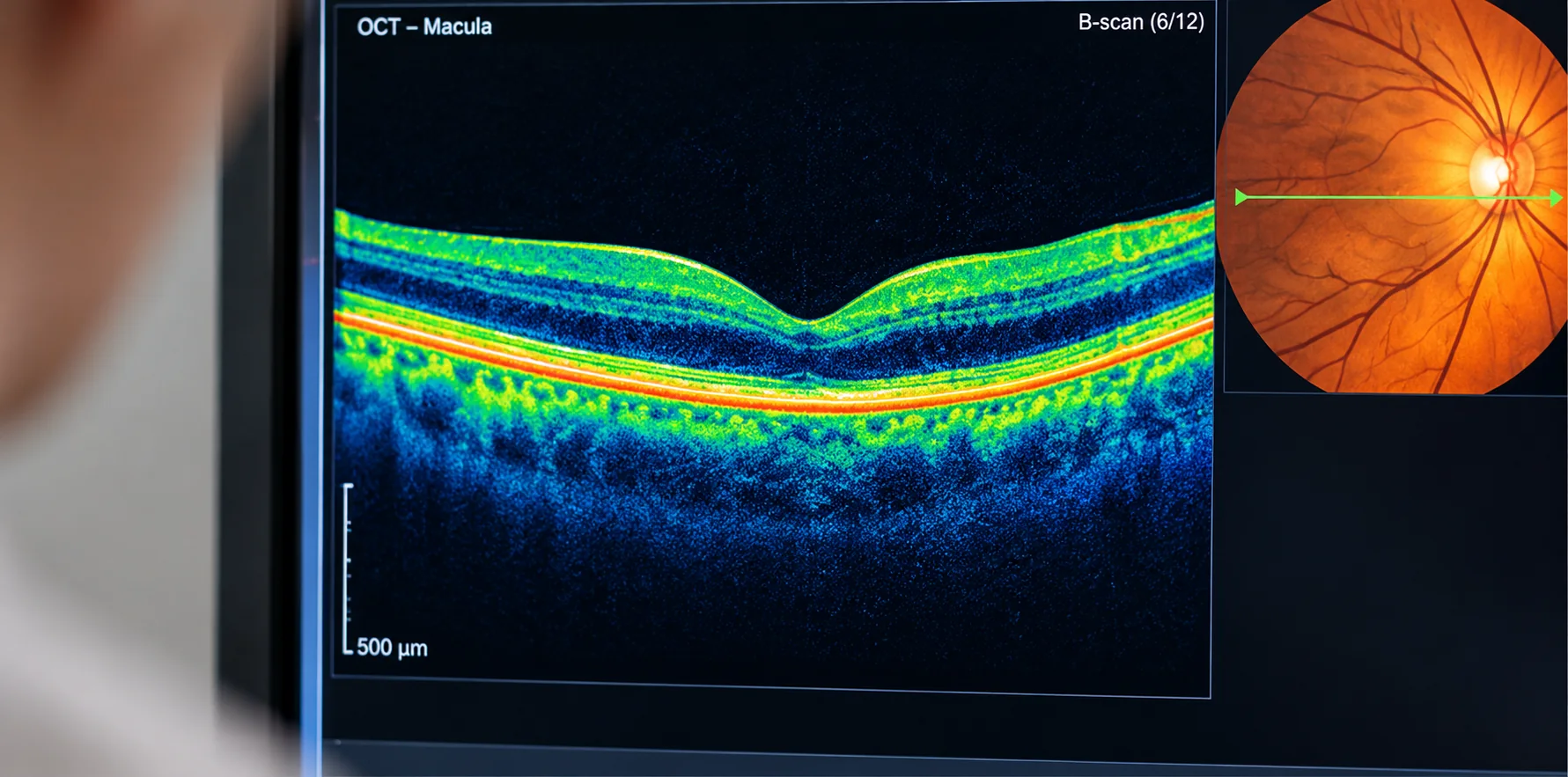
Optical coherence tomography (OCT) is a non invasive scan that produces detailed cross sectional images of structures at the back of the eye, including the macula. It can give the optometrist useful information to consider alongside your symptoms, vision checks and examination of the eye.
We provide a free OCT retinal scan with every eye test at our Shepherds Bush practice. The scan is one part of an eye examination and does not replace the full clinical assessment or any hospital tests that may be needed. Read more about our eye tests and OCT scans.
Search phrases related to AMD
People use different phrases when looking for information, including age related macular degeneration, amd, macular deterioration, wet macular degeneration, amd macular, ARMD macular degeneration, eye disorder macular degeneration and macular age degeneration. Searches may also contain repeated or incomplete wording, such as “macular degeneration macular degeneration” or “and macular degeneration”; these generally point to the same topic.
Frequently asked questions
What is age related macular degeneration?
Age related macular degeneration (AMD) is a condition affecting the macula, the central part of the retina used for detailed straight ahead vision.
What are common AMD symptoms?
AMD may cause blurred or distorted central vision, straight lines that look wavy, or difficulty with reading and recognising faces. Early AMD may have no noticeable symptoms.
What is the difference between wet and dry macular degeneration?
Dry AMD usually progresses more gradually. Wet AMD involves abnormal blood vessels and can cause vision to change more quickly, so new distortion or central blur should be assessed urgently.
Can an OCT scan check for AMD?
OCT provides detailed cross sectional images of the retina and macula and can support an eye health assessment. The optometrist considers it alongside the wider examination; an OCT scan alone is not a complete diagnosis.
How often should I have an eye test?
The NHS generally recommends an eye test every two years, or sooner if your optometrist advises it. If you already have AMD, follow the monitoring schedule set by your eye care team.
What should I do if straight lines suddenly look wavy?
Contact an optician or eye care service urgently for advice, particularly if this is a new change. Sudden loss of vision needs urgent medical attention.
Book an eye test with OCT in Shepherds Bush
If your vision has changed, or you are due an eye examination, contact Specialeyes Eyecare. We welcome walk in patients for enquiries, subject to appointment availability.
Book an eye testCall 020 8743 7552128 Uxbridge Road, Shepherds Bush, London W12 8AA · Monday to Saturday, 10:00am–6:00pm
Sources and further information
- NHS: Age related macular degeneration symptoms
- NHS: Getting diagnosed with AMD
- National Eye Institute: Age related macular degeneration
- NHS: Visiting an optician and regular eye tests
This article provides general information and is not a substitute for an eye examination or personalised clinical advice. Information reviewed 29 October 2026.
Clinical review
Clinically reviewed by: Hayder Ali, Qualified Optometrist
Last clinically reviewed:
Further clinical reading
For additional patient information and clinical guidance: