
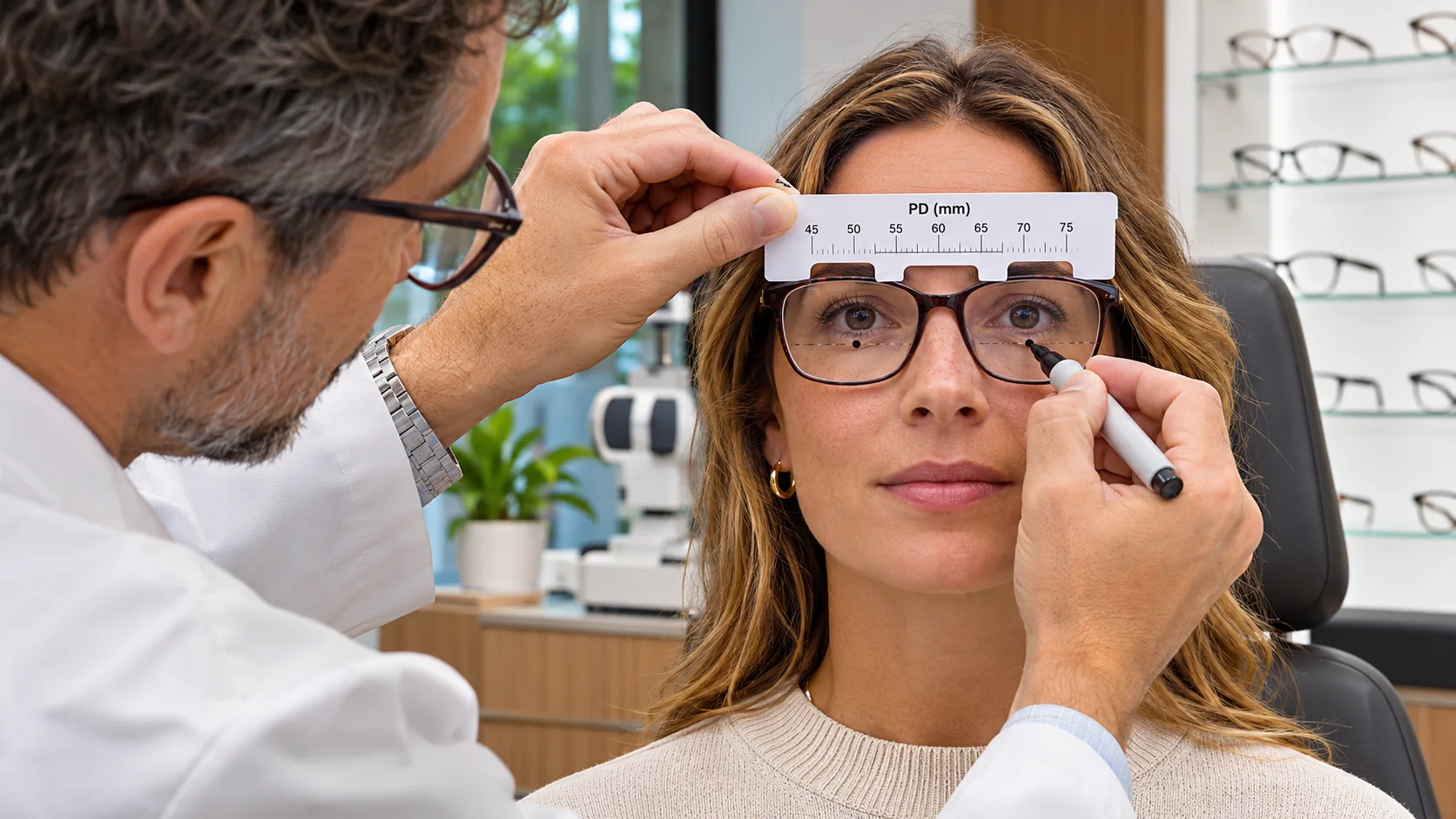
Pupillary distance (PD) is the distance between the centres of your pupils. When glasses are made, this measurement helps position each lens in front of the correct eye. But PD is not the only measurement needed to make glasses accurately: the frame must fit properly, and the relevant lens positions must be measured for the lens design.
What does pupillary distance measure?
PD describes the horizontal spacing of your pupils. It may be recorded as one binocular measurement or as two monocular measurements, one for each eye. Separate right and left measurements can be useful because faces and pupil positions are not always perfectly symmetrical.
For some lens designs and prescriptions, a near PD may also be relevant. Your eyes converge slightly when looking at something close, so near viewing positions differ from distance positions. The optician or dispensing team considers the intended use of the glasses and the lens type when taking measurements.
A PD measurement is usually recorded in millimetres. You may also see the terms pupil distance measurement or, informally, “PD distance”; these refer to the horizontal spacing used to centre the lenses for your eyes. To measure pupillary distance, the person taking the measurement needs to align the scale or measuring device with the centres of the pupils. In some prescriptions, each eye is measured separately rather than using one total distance.
PD is only one part of accurate glasses fitting
It is easy to think that knowing your PD is enough to order glasses. In practice, the finished result depends on more than that number. The prescription, lens material and design, frame size, how the frame sits on your face, and the position of the lenses all matter.
For example, fitting height is a vertical measurement: it describes where a particular reference point or viewing zone should sit in the lens when the frame is being worn. You can think of it as the up and down, or Y axis, part of positioning. The exact point measured depends on the lens design. Varifocal and occupational lenses need carefully placed viewing zones; bifocal lenses have a segment height; and single vision lenses still need to sit appropriately for the wearer and prescription.
Why optical centres matter
In a single vision lens, the optical centre is the point through which light passes without the lens producing prismatic effect. The lens position is planned so that you look through the appropriate part of each lens for your prescription and visual needs. Other lens designs have their own reference points and fitting marks, so the optical centre is not the only positioning measurement used for every pair.
If a powered lens is not positioned as intended, looking through an off centre area can introduce unwanted prism. Prism changes the direction in which light is bent. The amount and direction depend on the lens power and the size and direction of the decentration; the effect is not the same for every prescription.
Some people may notice eyestrain, discomfort, blurred or unsettled vision, difficulty adapting, or headaches. These symptoms can have many causes, so they do not prove that a measurement is wrong. If new glasses feel uncomfortable or vision does not seem right, return to the practice for a check of the prescription, frame adjustment and lens measurements.
Can I measure my PD online?
Online tools, printable rulers and phone camera features can help you measure your PD or estimate it at home. However, camera angle, distance, lighting, head position and pupil alignment can affect the result, especially when each eye needs a separate measurement. Repeatability matters: if repeated attempts give different numbers, do not guess which one is correct.
Some people search for measure pupillary distance online because they are ordering glasses remotely. An online measurement can be a starting point, but it does not check how your selected frame sits or provide fitting height and any other measurements needed for the lens design. A glasses provider, including an online seller, should have a process to ensure the lenses are correctly centred. The NHS guide to visiting an optician explains that PD is a dispensing measurement and may not appear on the eye test prescription.
If you are unsure how to measure PD online, or you have a strong prescription, noticeable facial asymmetry or multifocal lenses, ask an optical professional to take or verify the measurement in the chosen frame. Online measuring tools do not replace the prescription or the other checks needed to make glasses accurately.
Our guide to understanding your glasses prescription explains the prescription values themselves. A prescription and the measurements used to fit lenses are related, but they are not the same thing.
Our guide to understanding your glasses prescription explains the prescription values themselves. A prescription and the measurements used to fit lenses are related, but they are not the same thing.
What happens when measurements are taken in person?
The team checks the frame choice and fit, then takes the measurements needed for the chosen lens design. This may include horizontal pupil positions and vertical fitting heights. The measurements are taken with the frame adjusted as it will be worn, because a frame that sits too high, low, close or tilted can change where the lenses need to be positioned.
Tell the optician what you use the glasses for and mention any specific comfort or vision concerns. If you are replacing a pair that works well, bring it along so the team can discuss what you like about its fit and vision.
Frequently asked questions about pupillary distance
Is pupillary distance the same as fitting height?
No. PD is a horizontal measurement between the pupils (or from each pupil to the centre line). Fitting height is a vertical measurement used to position a lens reference point or viewing zone in the frame. Which measurements are needed depends on the lens design.
Is there one normal pupillary distance or average PD?
No single value is normal for everyone. The average pupillary distance or average PD is only a population level reference; your own measurement can be different and should be used for your glasses.
Can I measure my PD online?
Online tools and phone camera features can estimate PD, but results may vary with position, angle and technique. Check how the glasses provider verifies the measurement and whether your chosen lens design needs additional measurements.
Can I calculate PD from my prescription?
No. A glasses prescription gives lens powers and other optical details, but it does not calculate the distance between your pupils. PD is measured separately. If right and left monocular PDs are supplied, their sum gives the total binocular distance.
What can happen if my lenses are not positioned correctly?
Depending on the prescription and the size of the positioning error, unwanted prism or misplaced viewing zones may make vision uncomfortable or difficult to adapt to. Possible symptoms include eyestrain, discomfort, blurred vision and headaches, though these symptoms can have other causes too.
Do I need a fitting height for single vision glasses?
The measurements needed depend on the prescription, lens design and frame. Multifocal lenses usually need specific vertical measurements for their viewing zones. The dispensing team can confirm which measurements apply to your order.
Ask about glasses measurements in Shepherds Bush
Specialeyes Eyecare can help you choose frames and lenses and explain the measurements used for a comfortable fit. Visit us at 128 Uxbridge Road, Shepherds Bush, London W12 8AA, Monday to Saturday, 10am–6pm.
Call 020 8743 7552, book an eye test online, or message us on WhatsApp.