
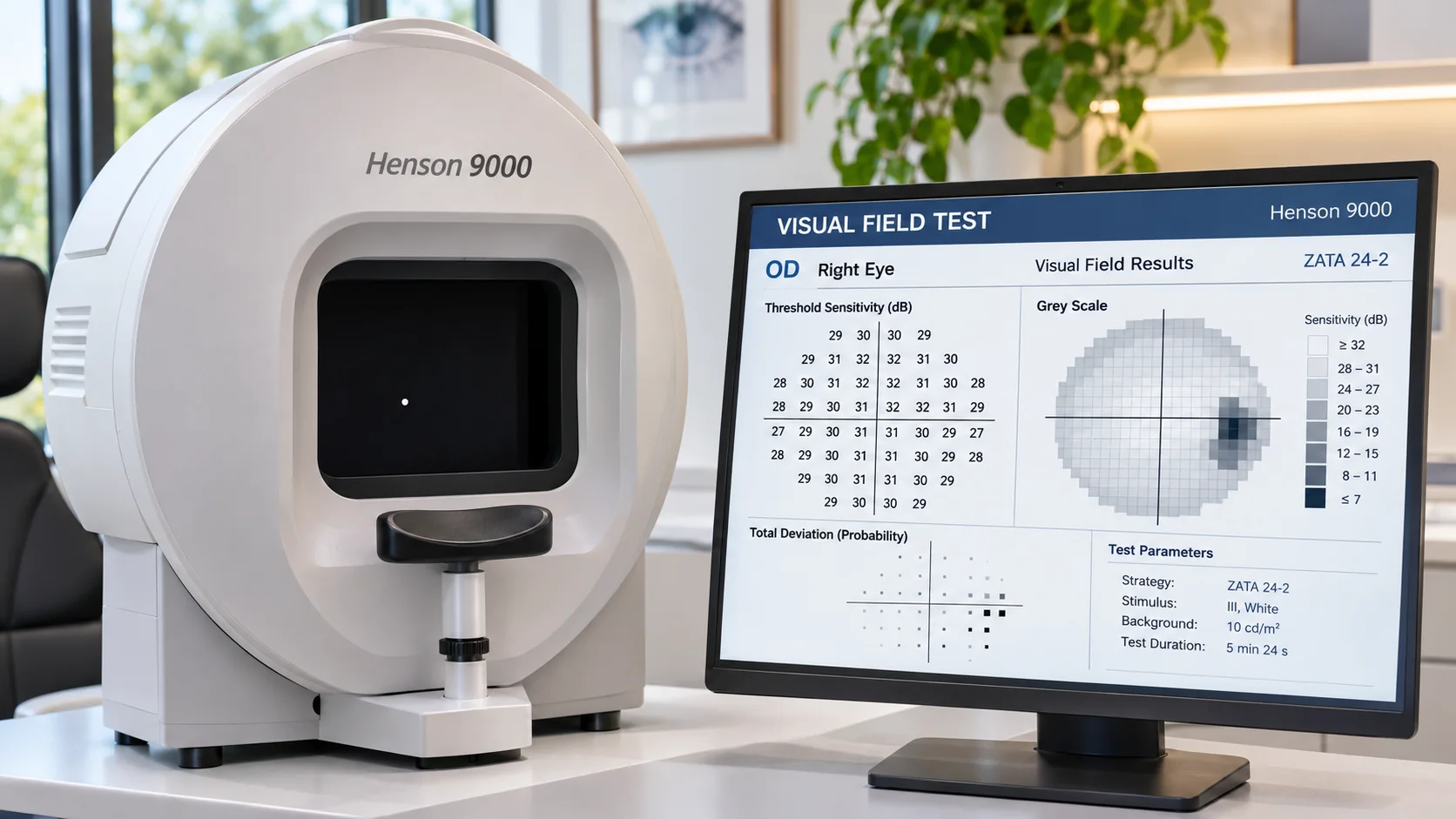
A visual field test measures how much you can see around you while keeping your gaze fixed in one direction. It checks central and peripheral vision, including areas you may not notice have become less clear or missing. A field of vision test can help an eye care professional investigate symptoms and monitor some eye or neurological conditions.
What is a visual field?
Your visual field is the whole area you can see at one time when your eyes are looking straight ahead. It includes central vision, which helps you see detail directly in front of you, and peripheral vision, which covers the surrounding area to the sides and above and below your point of focus.
To define peripheral vision simply, it is the part of your sight outside the central point you are directly looking at. It helps you notice movement and objects around you without turning your eyes or head towards them. Central vision can seem clear even when part of the peripheral field is reduced, so a person may not always notice a gradual change.
What does a visual field test check?
A visual field exam checks whether you can detect targets in different parts of your field of vision and, in some tests, how faint a target can be before it is missed. The test may assess each eye separately or both eyes together, depending on the clinical question and the type of assessment.
In a common automated test, you sit at an instrument, rest your chin and forehead on supports, and keep looking at a central fixation light. Small lights appear briefly in different places. You press a button when you see a light, but you will not be expected to see every flash. Some tests use moving targets instead of computer controlled flashes.
Why might an optician or eye doctor request one?
Checking visual fields can help with the assessment or monitoring of conditions that affect the retina, optic nerve or visual pathways between the eyes and brain. Visual field tests are commonly used in glaucoma care, where repeat results can help show whether peripheral sensitivity is changing. They may also be requested when symptoms or examination findings suggest a neurological or other field of vision problem.
A visual field assessment may also be used for a driving related examination when a licensing authority requests a specific test. A routine visual field test and a formal DVLA field assessment are not automatically interchangeable: the required method depends on the reason for testing. See our page about DVLA eye tests for information about our driving vision service.
What happens during the test?
The examiner will explain the instructions and position you at the machine. Usually one eye is tested at a time, with the other covered. You look at a central marker and press a response button when you notice a target in another part of the screen or bowl. A test may take several minutes per eye, depending on the method and the amount of information being collected.
- Keep looking at the central fixation point rather than following the lights.
- Press only when you see a target; do not worry if you miss one.
- Blink normally and try to stay relaxed.
- Tell the technician if you are uncomfortable, tired or unsure what to do.
The test is not usually painful, though concentrating can be tiring. It may be repeated if the clinician needs a more reliable baseline or wants to compare results over time. A repeat does not necessarily mean something is wrong.
Is an optical field test different from a visual field exam?
People may search for an optical field test, an eyesight field test or a field of vision test when they mean a visual field assessment. The name alone does not tell you which method will be used. Automated static perimetry, moving target tests and binocular driving assessments measure the field in different ways, so ask which test has been requested and why.
Searches such as “eye peripheral” often refer to peripheral vision or a peripheral vision test. The clinician will choose a test based on your symptoms, history and the purpose of the assessment.
Does the test diagnose an eye condition on its own?
No. A visual field result is one part of an eye assessment. The clinician considers it alongside your symptoms, eye examination and, when relevant, eye pressure, optic nerve appearance and imaging. A result may need repeating or further investigation before a diagnosis or treatment decision is made.
At Specialeyes Eyecare, visual field and OCT assessments may be considered as part of a broader eye health assessment where appropriate. Our team is at 128 Uxbridge Road, Shepherds Bush, London W12 8AA. You can read about our eye health checks in West London or our eye tests and OCT scans.
Frequently asked questions
How do you define peripheral vision?
Peripheral vision is the part of your visual field outside the point you are looking directly at. A visual field test checks how well you can detect targets in different areas around that point.
Can I fail a visual field test?
The test records what you see and how consistently you respond; it is not an exam you pass or fail. Missing a flash can happen, and results are interpreted in context. The clinician may repeat a test if needed.
Why do I need a visual field test if I can see clearly?
Central vision can remain clear even when a person has reduced sensitivity or a missing area elsewhere in the field. A visual field test checks those wider areas directly.
Will my test be the same as a DVLA field test?
Not necessarily. A DVLA assessment may require a particular method and set up. The clinician or licensing authority can confirm which test is required for your circumstances.
Arrange an eye health assessment in Shepherds Bush
If you have been asked to arrange a visual field test or are concerned about changes in your peripheral vision, contact Specialeyes Eyecare to discuss the appropriate next step. Call 020 8743 7552 or book an eye test online. Sudden loss of part of your vision needs urgent medical advice rather than a routine appointment.
Clinical review
Clinically reviewed by: Hayder Ali, Qualified Optometrist
Last clinically reviewed:
Further clinical reading
For additional patient information and clinical guidance: